Introduction
Martial arts mats are a fundamental part of any professional training environment, whether for Taekwondo, Karate, Judo, Brazilian Jiu-Jitsu (BJJ), Wrestling, or MMA. More than just floor covering, the right mat system plays a critical role in athlete safety, performance, and long-term facility durability.
This guide explains what martial arts mats are, how they are made, the different types available on the market, and how buyers can choose the right solution for their training center or distribution business.
1. What Are Martial Arts Mats?
Martial arts mats are specialized impact-absorbing flooring systems designed to reduce injury risk during training, sparring, and competition. Unlike ordinary gym flooring, these mats are engineered to absorb shock, disperse force, and provide controlled rebound during falls, throws, and dynamic movements.
They are commonly used in:
- Martial arts dojos
- Sports training centers
- Schools and universities
- Professional competition venues
- Home gyms
Depending on the discipline, mats may prioritize softness, stability, rebound, or surface grip.
2. Common Materials Used in Martial Arts Mats
The performance of a martial arts mat largely depends on its core material.
-
EVA Foam (Ethylene Vinyl Acetate)
EVA foam is the most widely used material due to its balance of flexibility, durability, and cost efficiency.
Lightweight and easy to install
Good shock absorption
Resistant to moisture and sweat
Ideal for puzzle mats and roll-out mats
-
PE Foam (Polyethylene)
PE foam is denser and firmer than EVA, often used in professional tatami systems.
Higher load-bearing capacity
Longer service life
Better suited for throwing-based sports like Judo
-
PU Foam
PU foam is commonly used in high-end competition mats.
Excellent energy absorption
Consistent rebound
Higher cost, mainly for professional events
3. Main Types of Martial Arts Mats
-
Puzzle Mats (Interlocking Mats)
Puzzle mats are modular mats with interlocking edges.
Easy installation without tools
Flexible layout and expansion
Popular for Taekwondo, Karate, and home gyms
-
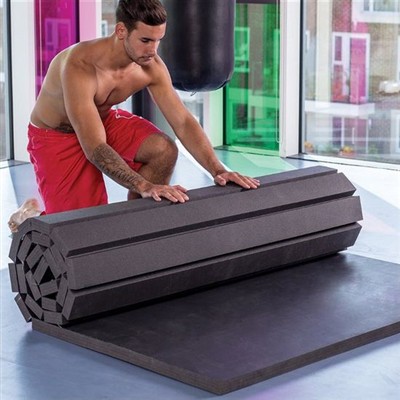
Roll-Out Mats
Roll-out mats are large sheets that can be quickly unrolled.
Seamless surface
Fast setup and storage
Common in competitions and multi-purpose halls
-
Tatami Mats
Tatami mats are traditionally thicker and denser.
Superior shock absorption
Designed for throws and grappling
Standard choice for Judo and BJJ
4. Thickness and Safety Considerations
Thickness directly affects injury prevention:
- 20–25 mm: Light training and striking-based martial arts
- 30–40 mm: Mixed training and grappling
- 40–50 mm: High-impact throwing sports
Thicker mats absorb more energy but may reduce movement speed if density is too low. Therefore, thickness must be matched with proper foam density.
5. Surface Texture and Grip
The surface of martial arts mats is designed to provide:
- Anti-slip performance
- Skin-friendly contact
- Resistance to wear and tearing
Textures vary depending on sport requirements. For example, Taekwondo mats often feature slightly textured surfaces for fast footwork, while Judo mats focus on grip and stability.
6. Hygiene and Maintenance
Modern martial arts mats are designed for easy cleaning:
- Closed-cell foam prevents water absorption
- Smooth surfaces resist bacteria buildup
- Suitable for daily cleaning with mild detergents
This is especially important for gyms and training centers with high daily usage.
7. Choosing Mats for Commercial Use
When buying mats for commercial or wholesale purposes, key factors include:
- Consistent foam density across batches
- Color matching for large areas
- Edge and corner accessories
- Long-term durability
Bulk buyers should always prioritize factory-controlled production rather than mixed sourcing.
8. Customization Options
Professional manufacturers offer:
- Custom sizes and thickness
- Color combinations and zoning
- Logo printing or embossing
- OEM and ODM solutions
Customization helps gyms build strong brand identity and meet competition standards.
9. Why Factory-Direct Sourcing Matters
Sourcing martial arts mats directly from a manufacturing factory ensures:
- Better cost control
- Stable quality
- Flexible customization
- Reliable delivery schedules
This is especially important for distributors and project-based buyers.